Antiquated Egypt was a human progress of old Northeastern Africa,
thought along the lower ranges of the Nile River in what is presently
the present day nation of Egypt. It is one of six civilizations all
inclusive to emerge autonomously. Egyptian development combine around
3150 BC (as indicated by routine Egyptian chronology)[1] with the
political unification of Upper and Lower Egypt under the first
pharaoh.[2] The historical backdrop of old Egypt happened in a
progression of stable Kingdoms, isolated by times of relative shakiness
known as Intermediate Periods: the Old Kingdom of the Early Bronze Age,
the Middle Kingdom of the Middle Bronze Age and the New Kingdom of the
Late Bronze Age.
Egypt came to the apex of its energy amid the New Kingdom, in
the Ramesside period where it equaled the Hittite Empire, Assyrian
Empire and Mitanni Empire, after which it entered a time of moderate
decay. Egypt was attacked or vanquished by a progression of outside
forces, for example, the Canaanites/Hyksos, Libyans, the Nubians, the
Assyrians, Babylonians, the Achaemenid Persians, and the Macedonians in
the Third Intermediate Period and the Late Period of Egypt. In the
repercussions of Alexander the Great's demise, one of his commanders,
Ptolemy Soter, set up himself as the new leader of Egypt. This Greek
Ptolemaic Dynasty ruled Egypt until 30 BC, when, under Cleopatra, it
tumbled to the Roman Empire and turned into a Roman province.[3]
The accomplishment of antiquated Egyptian human advancement came
mostly from its capacity to adjust to the states of the Nile River
valley for horticulture. The anticipated flooding and controlled
watering system of the fruitful vall

ey
delivered surplus harvests, which bolstered a more thick populace, and
social improvement and society. With assets to extra, the organization
supported mineral abuse of the valley and encompassing desert locales,
the early improvement of an autonomous written work framework, the
association of aggregate development and agrarian ventures, exchange
with encompassing districts, and a military planned to thrashing outside
foes and attest Egyptian predominance. Propelling and sorting out these
exercises was an administration of world class copyists, religious
pioneers, and heads under the control of a pharaoh, who guaranteed the
collaboration and solidarity of the Egyptian individuals in the setting
of an extensive arrangement of religious beliefs.[4][5]
The numerous accomplishments of the old Egyptians incorporate
the quarrying, looking over and development systems that upheld the
building of momentous pyramids, sanctuaries, and monoliths; an
arrangement of math, a commonsense and viable arrangement of
pharmaceutical, watering system frameworks and agrarian generation
methods, the first known ships,[6] Egyptian faience and glass
innovation, new types of writing, and the soonest known peace bargain,
made with the Hittites.[7] Egypt left an enduring legacy. Its
craftsmanship and construction modeling were broadly duplicated, and its
artifacts stole away to far corners of the world. Its fantastic
remnants have propelled the creative abilities of explorers and
journalists for a considerable length of time. A recently discovered
appreciation for ancient pieces and unearthings in the early cutting
edge period by Europeans and Egyptians prompted the logical examination
of Egyptian progress and a more noteworthy valuation for its social
legacy.[8]
Map of ancient Egypt, showing major cities and sites of the Dynastic period (c. 3150 BC to 30 BC)

The
Nile has been the lifeline of its region for much of human history.
[9]
The fertile floodplain of the Nile gave humans the opportunity to
develop a settled agricultural economy and a more sophisticated,
centralized society that became a cornerstone in the history of human
civilization.
[10]
Nomadic modern human hunter-gatherers began living in the Nile valley
through the end of the Middle Pleistocene some 120,000 years ago. By the
late Paleolithic
period, the arid climate of Northern Africa became increasingly hot and
dry, forcing the populations of the area to concentrate along the river
region.
In Predynastic and Early Dynastic times, the Egyptian atmosphere was
considerably less dry than it is today. Huge locales of Egypt were
secured in treed savanna and crossed by groups of touching ungulates.
Foliage and fauna were much more productive in all environs and the Nile
locale upheld huge populaces of waterfowl. Chasing would have been
basic for Egyptians, and this is additionally the period when numerous
creatures were first domesticated.[11]
By around 5500 BC, little
tribes living in the Nile valley had formed into a progression of
societies exhibiting firm control of farming and creature cultivation,
and identifiable by their ceramics and individual things, for example,
brushes, wrist trinkets, and dabs. The biggest of these early societies
in upper (Southern) Egypt was the Badari, which presumably started in
the Western Desert; it was known for its top notch pottery, stone
devices, and its utilization of copper.[12]
The Badari was
trailed by the Amratian (Naqada I) and Gerzeh (Naqada II) cultures,[13]
which brought various mechanical changes. As ahead of schedule as the
Naqada I Period, predynastic Egyptians imported obsidian from Ethiopia,
used to shape edges and different items from flakes.[14] In Naqada II
times, right on time proof exists of contact with the Near East,
especially Canaan and the Byblos coast.[15] Over a time of around 1,000
years, the Naqada society created from a couple of little cultivating
groups into a capable civilization whose pioneers were in complete
control of the individuals and assets of the Nile valley.[16]
Establishing a force focus at Hierakonpolis, and later at Abydos, Naqada
III pioneers extended their control of Egypt northwards along the
Nile.[17] They additionally exchanged with Nubia toward the south, the
desert springs of the western desert toward the west, and the way of
life of the eastern Mediterranean and Near East toward the east.[17]
Royal Nubian internments at Qustul delivered ancient rarities bearing
the most seasoned known samples of Egyptian dynastic images, for
example, the white crown of Egypt and falcon.[18][19]
The Naqada
society fabricated a different determination of material merchandise,
intelligent of the expanding influence and abundance of the tip top, and
additionally societal individual utilization things, which included
brushes, little statuary, painted ceramics, top notch beautifying stone
vases, nonessential palettes, and gems made of gold, lapis, and ivory.
They additionally built up an earthenware coating known as faience,
which was utilized well into the Roman Period to embellish containers,
ornaments, and figurines.[20] During the last predynastic stage, the
Naqada society started utilizing composed images that inevitably were
produced into a full arrangement of pictographs for composing the
antiquated Egyptian language.[21]
Early Dynastic Period (c. 3050–2686 BC)
Principle article: Early Dynastic Period of Egypt
The
Early Dynastic Period was more or less contemporary to the early
Sumerian-Akkadian civilisation of Mesopotamia and of old Elam. The
third-century BC Egyptian minister Manetho gathered the long line of
pharaohs from Menes to his own particular time into 30 administrations, a
framework still utilized today.[22] He decided to start his official
history with the lord named "Meni" (or Menes in Greek) why should
accepted have united the two kingdoms of Upper and Lower Egypt (around
3100 BC).[23]
The move to a bound together state happened more
slowly than antiquated Egyptian scholars spoke to, and there is no
contemporary record of Menes. A few researchers now accept, on the other
hand, that the legendary Menes may have been the pharaoh Narmer, who is
portrayed wearing regal formal attire on the stylized Narmer Palette,
in a typical demonstration of unification.[24] In the Early Dynastic
Period around 3150 BC, the first of the Dynastic pharaohs hardened
control over lower Egypt by building up a capital at Memphis, from which
he could control the work power and agribusiness of the fruitful delta
locale, and also the lucrative and discriminating exchange courses to
the Levant. The expanding influence and abundance of the pharaohs amid
the early dynastic period was reflected in their intricate mastaba tombs
and funeral home faction structures at Abydos, which were utilized to
praise the exalted pharaoh after his death.[25] The solid foundation of
majesty grew by the pharaohs served to legitimize state control over the
area, work, and assets that were vital to the surviv
Significant advances in structural engineering, craftsmanship, and
innovation were made amid the Old Kingdom, filled by the expanded
agrarian efficiency and coming about populace, made conceivable by a
very much created focal administration.[28] Some of old Egypt's most
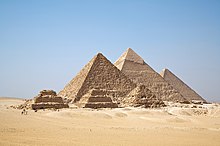
distinguished accomplishments, the Giza pyramids and Great Sphinx, were
developed amid the Old Kingdom. Under the bearing of the vizier, state
authorities gathered duties, facilitated watering system activities to
enhance product yield, drafted laborers to chip away at development
extends, and set up an equity framework to keep up peace and order.[29]
Khafre Enthroned
Alongside
the rising significance of a focal organization emerged another class
of instructed copyists and authorities who were conceded bequests by the
pharaoh in installment for their administrations. Pharaohs likewise
made area stipends to their morgue cliques and neighborhood sanctuaries,
to guarantee that these organizations had the assets to love the
pharaoh after his passing. Researchers accept that five centuries of
these practices gradually dissolved the monetary force of the pharaoh,
and that the economy could no more bear to bolster a substantial
concentrated administration.[30] As the force of the pharaoh decreased,
local governors called nomarchs started to test the amazingness of the
pharaoh. This, combined with extreme dry seasons somewhere around 2200
and 2150 BC,[31] is expected to have brought on the nation to enter the
140-year time of starvation and strife known as the First Intermediate
Period.[32]
In the first place Intermediate Period (2181–1991 BC)
Primary article: First Intermediate Period of Egypt
After
Egypt's focal government broken down toward the end of the Old Kingdom,
the organization could no more bolster or settle the nation's economy.
Territorial governors couldn't depend on the ruler for help in times of
emergency, and the resulting sustenance deficiencies and political
question swelled into starvations and little scale common wars. Yet
regardless of troublesome issues, neighborhood pioneers, owing no
tribute to the pharaoh, utilized their freshly discovered autonomy to
set up a flourishing culture in the regions. Once in control they could
call their own assets, the areas turned out to be monetarily wealthier
which was shown by bigger and better internments among all social
classes.[33] In blasts of imagination, common artisans embraced and
adjusted social themes previously limited to the sovereignty of the Old
Kingdom, and recorders created abstract styles that communicated the
good faith and innovation of the period.[34]
Free from their
loyalties to the pharaoh, neighborhood rulers started contending with
one another for regional control and political force. By 2160 BC, rulers
in Herakleopolis controlled Lower Egypt in the north, while an opponent
group situated in Thebes, the Intef family, took control of Upper Egypt
in the south. As the Intefs developed in force and extended their
control northward, a conflict between the two opponent traditions got to
be inexorable. Around 2055 BC the northern Theban constrains under
Nebhepetre Mentuhotep II at last vanquished the Herakleopolitan rulers,
rejoining the Two Lands. They initiated a time of monetary and social
renaissance known as the Middle Kingdom.[35]
Center Kingdom (2134–1690 BC)
Fundamental article: Middle Kingdom of Egypt
Amenemhat III, the last awesome leader of the Middle Kingdom
The
pharaohs of the Middle Kingdom restored the nation's thriving and
solidness, in this manner animating a resurgence of craftsmanship,
writing, and fantastic building projects.[36] Mentuhotep II and his
Eleventh Dynasty successors ruled from Thebes, yet the vizier Amenemhat
I, after accepting sovereignty toward the start of the Twelfth Dynasty
around 1985 BC, moved the country's funding to the city of Itjtawy,
situated in Faiyum.[37] From Itjtawy, the pharaohs of the Twelfth
Dynasty embraced a far-located area recovery and watering system plan to
expand horticultural yield in the district. Also, the military
reconquered domain in Nubia that was rich in quarries and gold mines,
while workers manufactured a cautious structure in the Eastern Delta,
called the "Dividers of-the-Ruler", to shield against remote attack.[38]
With the pharaohs' having secured military and political
security and unfathomable farming and mineral riches, the country's
populace, expressions, and religion prospered. As opposed to elitist Old
Kingdom disposition towards the divine beings, the Middle Kingdom
encountered an increment in articulations of individual devotion and
what could be known as a democratization of life following death, in
which all individuals had a spirit and could be invited into the
organization of the divine beings after death.[39] Middle Kingdom
writing highlighted advanced subjects and characters written in a sure,
expressive style.[34] The help and representation model of the period
caught inconspicuous, individual subtle elements that came to new
statures of specialized perfection.[40]
The last awesome leader
of the Middle Kingdom, Amenemhat III, permitted Semitic-speaking
Canaanite pilgrims from the Near East into the delta locale to give an
adequate work power to his particularly dynamic mining and building
crusades. These driven building and mining exercises, be that as it may,
joined with serious Nile surges later in his rule, strained the economy
and hastened the moderate decrease into the Second Intermediate Period
amid the later Thirteenth and Fourteenth traditions. Amid this decrease,
the Canaanite pilgrims started to seize control of the delta area, in
the long run coming to power in Egypt as the Hyksos.[41]
Second Intermediate Period (1674–1549 BC) and the Hyksos
Primary article: Second Intermediate Period of Egypt
Around
1785 BC, as the force of the Middle Kingdom pharaohs debilitated, a
Semitic Canaanite individuals called the Hyksos had officially settled
in the Eastern Delta town of Avaris, seized control of Egypt, and
constrained the focal government to withdraw to Thebes. The pharaoh was
dealt with as a vassal and anticipated that would pay tribute.[42] The
Hyksos ("outside rulers") held Egyptian models of government and
distinguished as pharaohs, therefore incorporating Egyptian components
into their way of life. They and other Semitic trespassers brought new
devices of fighting into Egypt, most remarkably the composite bow and
the stallion drawn chariot.[43]
After their retreat, the local
Theban rulers discovered themselves caught between the Canaanite Hyksos
administering the north and the Hyksos' Nubian associates, the Kushites,
toward the south of Egypt. Following quite a while of vassalage, Thebes
sufficiently assembled quality to test the Hyksos in a contention that
endured over 30 years, until 1555 BC.[42] The pharaohs Seqenenre Tao II
and Kamose were eventually ready to thrashing the Nubians toward the
south of Egypt, however neglected to annihilation the Hyksos. That
errand tumbled to Kamose's successor, Ahmose I, who effectively pursued a
progression of battles that forever annihilated the Hyksos' vicinity in
Egypt. He built up another administration. In the New Kingdom that took
after, the military turned into a focal need for the pharaohs looking
to extend Egypt's outskirts and endeavoring to pick up dominance of the
Near East.[44]
The most extreme regional degree of antiquated Egypt (15th century BC)
New Kingdom (1549–1069 BC)
Primary article: New Kingdom
The
New Kingdom pharaohs built up a time of phenomenal success by securing
their outskirts and fortifying discretionary ties with their neighbors,
including the Mitanni Empire, Assyria, and Canaan. Military crusades
pursued under Tuthmosis I and his grandson Tuthmosis III developed the
impact of the pharaohs to the biggest domain Egypt had ever seen.
Between their rules, Hatshepsut by and large advanced peace and restored
exchange courses lost amid the Hyksos occupation, and in addition
growing to new locales. At the point when Tuthmosis III kicked the
bucket in 1425 BC, Egypt had a realm stretching out from Niya in north
west Syria to the fourth waterfall of the Nile in Nubia, solidifying
loyalties and opening access to discriminating imports, for example,
bronze and
The New Kingdom pharaohs started an expansive scale building crusade to
advance the god Amun, whose developing faction was situated in Karnak.
They likewise developed landmarks to extol their own accomplishments,
both genuine and envisioned. The Karnak sanctuary is the biggest
Egyptian sanctuary ever built.[46] The pharaoh Hatshepsut utilized such
metaphor and loftiness amid her rule of very nearly twenty-two
years.[47] Her rule was extremely effective, stamped by an augmented
time of peace and riches building, exchanging campaigns to Punt,
reclamation of outside exchange systems, and incredible building
activities, including a rich funeral home sanctuary that equaled the
Greek structural engineering of a thousand years after the fact, an epic
pair of monoliths, and a house of prayer at Karnak. Regardless of her
accomplishments, Amenhotep II, the beneficiary to Hatshepsut's
nephew-stepson Tuthmosis III, tried to eradicate her legacy close to the
end of his dad's rule and all through his, touting large portions of
her achievements as his.[48] He additionally attempted to change
numerous built up conventions that had grown throughout the hundreds of
years, which some propose was a useless endeavor to keep other ladies
from getting to be pharaoh and to control their impact in the kingdom.
Around
1350 BC, the dependability of the New Kingdom appeared to be undermined
further when Amenhotep IV rose the throne and initiated a progression
of radical and clamorous changes. Changing his name to Akhenaten, he
touted the beforehand cloud sun god Aten as the preeminent god, stifled
the love of most different gods, and assaulted the force of the
sanctuary that had get to be commanded by the ministers of Amun in
Thebes, whom he saw as corrupt.[49] Moving the money to the new city of
Akhetaten (current Amarna), Akhenaten turned a hard of hearing ear to
occasions in the Near East (where the Hittites, Mitanni, and Assyrians
were competing for control). He was given to his new religion and
imaginative style. After his demise, the religion of the Aten was
immediately deserted, the clerics of Amun soon recovered power and gave
back the funding to Thebes. Under their impact the consequent pharaohs
Tutankhamun, Ay, and Horemheb attempted to eradicate all notice of
Akhenaten's apostasy, now known as the Amarna Period.[50]
Four gigantic statues of Ramesses II flank the passageway of his sanctuary Abu Simbel
Around
1279 BC, Ramesses II, otherwise called Ramesses the Great, rose the
throne, and went ahead to manufacture more sanctuaries, erect more
statues and monoliths, and sire a larger number of kids than some other
pharaoh in history.[51] A strong military pioneer, Ramesses II drove his
armed force against the Hittites in the Battle of Kadesh (in current
Syria) and, subsequent to battling to a stalemate, at long last
consented to the initially recorded peace settlement, around 1258
BC.[52] With both the Egyptians and Hittite Empire demonstrating not
able to pick up the high ground more than each other, and both powers
additionally dreadful of the extending Middle Assyrian Empire, Egypt
withdrew from a great part of the Near East. The Hittites were in this
manner left to contend unsuccessfully with the effective Assyrians and
the recently arrived Phrygians.
Egypt's riches, notwithstanding,
made it an enticing focus for intrusion, especially by the Libyan
Berbers toward the west, and the Sea Peoples, a conjectured[53][54]
confederation of seafarers from the Aegean. At first, the military had
the capacity repulse these intrusions, yet Egypt in the long run lost
control of its remaining regions in southern Caanan, quite a bit of it
tumbling to the Assyrians. The impacts of outer dangers were exacerbated
by inner issues, for example, defilement, tomb theft, and common
turmoil. Subsequent to recovering their influence, the esteemed clerics
at the sanctuary of Amun in Thebes gathered incomprehensible tracts of
area and riches, and their extended influence chipped the nation amid
the Third Intermediate Period.[55]
Third Intermediate Period (1069–653 BC)
Primary article: Third Intermediate Period of Egypt
Taking
after the demise of Ramesses XI in 1078 BC, Smendes accepted power over
the northern piece of Egypt, decision from the city of Tanis. The south
was adequately controlled by the High Priests of Amun at Thebes, who
perceived Smendes in name only.[56] During this time, Berber tribes from
what was later to be called Libya had been settling in the western
delta, and the chieftains of these pioneers started expanding their
independence. Libyan rulers took control of the delta under Shoshenq I
in 945 BC, establishing the Libyan Berber, or Bubastite, tradition that
led for exactly 200 years. Shoshenq likewise picked up control of
southern Egypt by putting his relatives in vital religious positions.
In
the mid-ninth century BC, Egypt made a fizzled endeavor to again pick
up a solid footing in Western Asia. Osorkon II of Egypt, alongside a
huge organization together of countries and people groups, including
Persia, Israel, Hamath, Phoenicia/Caanan, the Arabs, Arameans, and neo
Hittites among others, occupied with the Battle of Karkar against the
intense Assyrian lord Shalmaneser III in 853 BC. Then again, this
coalition of forces fizzled and the Neo Assyrian Empire kept on
overwhelming Western Asia.
Libyan Berber control started to
dissolve as an adversary local tradition in the delta emerged under
Leontopolis. Likewise, the Nubians of the Kushites debilitated Egypt
from the terrains toward the south.[57]
Around 730 BC Libyans from the west broke the political solidarity of the nation
Drawing
on centuries of cooperation (exchange, cultural assimilation,
occupation, osmosis, and war[58]) with Egypt,[59] the Kushite lord Piye
left his Nubian capital of Napata and attacked Egypt around 727 BC. Piye
effectively seized control of Thebes and in the long run the Nile
Delta.[60] He recorded the scene on his stela of triumph. Piye set the
stage for ensuing Twenty-fifth tradition pharaohs,[61], for example,
Taharqa, to rejoin the "Two grounds" of Northern and Southern Egypt. The
Nile valley domain was as expansive as it had been subsequent to the
New Kingdom.
The Twenty-fifth tradition introduced a renaissance
period for old Egypt.[62] Religion, expressions of the human
experience, and building design were restored to their superb Old,
Middle, and New Kingdom frames. Pharaohs, for example, Taharqa,
fabricated or restored sanctuaries and landmarks all through the Nile
valley, including at Memphis, Karnak, Kawa, Jebel Barkal, etc.[63] It
was amid the Twenty-fifth administration that there was the first
boundless development of pyramids (numerous in current Sudan) in the
Nile Valley since the Middle Kingdom.[64][65][66]
Piye made
different unsuccessful endeavors to broaden Egyptian impact in the Near
East, then controlled by Assyria. In 720 BC, he sent an armed force in
backing of a resistance to Assyria, which was occurring in Philistia and
Gaza. Notwithstanding, Piye was vanquished by Sargon II and the
insubordination fizzled. In 711 BC, Piye again bolstered a rebellion
against the Assyrians by the Israelites of Ashdod and was by and by
crushed by the Assyrian lord Sargon II. Thusly, Piye was constrained
from the Near East.[67]
From the 10th century BC onwards,
Assyria battled for control of the southern Levant. Much of the time,
urban areas and kingdoms of the southern Levant engaged Egypt for
assistant in their battles against the intense Assyrian armed force.
Taharqa appreciated some beginning achievement in his endeavors to
recapture a solid footing in the Near East. Taharqa supported the Judean
King Hezekiah when Hezekiah and Jerusalem was assaulted by the Assyrian
ruler, Sennacherib. Researchers differ on the essential purpose behind
Assyria's surrender of their attack on Jerusalem. Purposes behind the
Assyrian withdrawal extent from clash with the Egyptian/Kushite armed
force to heavenly mediation to surrender to disease.[68] Henry Aubin
contends that the Kushite/Egyptian armed force spared Jerusalem from the
Assyrians and kept the Assyrians from coming back to catch Jerusalem
for the rest of Sennacherib's life (20 years).[69] Some contend that
illness was the essential explanation behind neglecting to really take
the city, however Senacherib's records claim Judah was constrained into
tribute regardless.[70]
Sennacherib had been killed by his own
children for crushing the defiant city of Babylon, a city consecrated to
all Mesopotamians, the Assyrians included. In 674 BC Esarhaddon
dispatched a preparatory invasion into Egypt, however this endeavor was
repulsed by Taharqa.[71] However, In 671 BC, Esarhaddon propelled a
full-scale attack. A piece of his armed force stayed behind to manage
uprisings in Phoenicia, and Israel. The rest of south to Rapihu, then
crossed the Sinai, and entered Egypt. Esarhaddon unequivocally
vanquished Taharqa, took Memphis, Thebes and all the real urban areas of
Egypt, and Taharqa was pursued back to his Nubian country. Esarhaddon
now called himself "lord of Egypt, Patros, and Kush", and came back with
rich goods from the urban communities of the delta; he raised a triumph
stele as of now, and paraded the hostage Prince Ushankhuru, the child
of Taharqa in Nineveh. Esarhaddon positioned a little armed force in
northern Egypt and portrays how "All Ethiopians (read Nubians/Kushites) I
expelled from Egypt, leaving not one left to do respect to me".[72] He
introduced local Egyptian sovereigns all through the area to administer
on his behalf.[73] The victory by Esarhaddon successfully denoted the
end of the fleeting Kushite Empire.
Notwithstanding, the local
Egyptian rulers introduced by Esarhaddon were not able to hold full
control of the entire nation for long. After two years, Taharqa came
back from Nubia and seized control of a segment of southern Egypt as far
north as Memphis. Esarhaddon arranged to come back to Egypt and afresh
discharge Taharqa, in any case he fell sick and kicked the bucket in his
capital, Nineveh, preceding he exited Assyria. His successor,
Ashurbanipal, sent an Assyrian general named Sha-Nabu-shu with a little,
yet very much prepared armed force, which indisputably crushed Taharqa
at Memphis and yet again drove him from Egypt. Taharqa passed on in
Nubia two years after the fact.
Twenty-fifth Dynasty
His
successor, Tanutamun, additionally made a fizzled endeavor to recapture
Egypt for Nubia. He effectively crushed Necho, the local Egyptian
manikin ruler introduced by Ashurbanipal, taking Thebes all the while.
The Assyrians then sent a hu
 Map of ancient Egypt, showing major cities and sites of the Dynastic period (c. 3150 BC to 30 BC)

