Nefertiti Bust
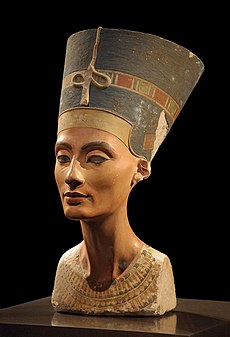 The
Nefertiti Bust is a 3,300-year-old painted limestone bust of Nefertiti,
the Great Royal Wife of the Egyptian Pharaoh Akhenaten, and a standout
amongst the most replicated works of antiquated Egypt. Inferable from
the work, Nefertiti has turn into a standout amongst the most celebrated
ladies of the antiquated world, and a symbol of ladylike magnificence.
The work is accepted to have been created in 1345 BC by the artist
Thutmose.
The
Nefertiti Bust is a 3,300-year-old painted limestone bust of Nefertiti,
the Great Royal Wife of the Egyptian Pharaoh Akhenaten, and a standout
amongst the most replicated works of antiquated Egypt. Inferable from
the work, Nefertiti has turn into a standout amongst the most celebrated
ladies of the antiquated world, and a symbol of ladylike magnificence.
The work is accepted to have been created in 1345 BC by the artist
Thutmose. A German archeological group drove by Ludwig Borchardt found the Nefertiti bust in 1912 in Thutmose's workshop in Amarna, Egypt. It has been kept at a few areas in Germany since its disclosure, incorporating a salt mine in Merkers-Kieselbach, the Dahlem gallery (then in West Berlin), the Egyptian Museum in Charlottenburg and the Altes Museum. It is right now in plain view at the restored and as of late re-opened Neues Museum in Berlin, where it was shown before World War II.
The Nefertiti bust has turn into a social image of Berlin, Germany, and additionally of antiquated Egypt. Nefertiti herself has turn out to be truly an Icon. Nefertiti is generally known for her excellence and adaptability. It has additionally been the subject of a serious contention in the middle of Egypt and Germany over Egyptian requests for its repatriation. It was dragged into debates over the Body of Nefertiti workmanship presentation furthermore by affirmations with respect to its authenticity.[2]
 Nefertiti
(signifying "the wonderful one has come") was the 14th-century BC Great
Royal Wife (boss partner) of the Egyptian Pharaoh Akhenaten of the
Eighteenth administration of Egypt. Akhenaten started another
monotheistic type of love called Atenism committed to the Sun plate
Aten.[3] Little is thought about Nefertiti. Hypotheses propose she could
have been an Egyptian imperial by conception, an outside princess or
the girl of a high government authority named Ay, who got to be pharaoh
after Tutankhamun. She may have been the co-official of Egypt with
Akhenaten, who ruled from 1352 BC to 1336 BC.[3] Nefertiti bore six
girls to Akhenaten, one of whom, Ankhesenpaaten (renamed Ankhesenamun
after the concealment of the Aten faction), wedded Tutankhamun,
Nefertiti's stepson. Nefertiti vanishes from history in the twelfth year
of Akhenaten's
rule, however whether this is because of her passing or on the grounds
that she took another name is not known. She might likewise have later
turn into a pharaoh in her own right, controlling alone for a brief
while after her spouse's death.[3][4]
Nefertiti
(signifying "the wonderful one has come") was the 14th-century BC Great
Royal Wife (boss partner) of the Egyptian Pharaoh Akhenaten of the
Eighteenth administration of Egypt. Akhenaten started another
monotheistic type of love called Atenism committed to the Sun plate
Aten.[3] Little is thought about Nefertiti. Hypotheses propose she could
have been an Egyptian imperial by conception, an outside princess or
the girl of a high government authority named Ay, who got to be pharaoh
after Tutankhamun. She may have been the co-official of Egypt with
Akhenaten, who ruled from 1352 BC to 1336 BC.[3] Nefertiti bore six
girls to Akhenaten, one of whom, Ankhesenpaaten (renamed Ankhesenamun
after the concealment of the Aten faction), wedded Tutankhamun,
Nefertiti's stepson. Nefertiti vanishes from history in the twelfth year
of Akhenaten's
rule, however whether this is because of her passing or on the grounds
that she took another name is not known. She might likewise have later
turn into a pharaoh in her own right, controlling alone for a brief
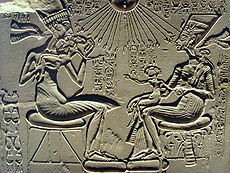
while after her spouse's death.[3][4] The bust of Nefertiti is accepted to have been created around 1345 BC by the stone worker Thutmose.[3][5] The bust does not have any engravings, but rather can be surely distinguished as Nefertiti by the trademark crown, which she wears in other surviving (and obviously marked) portrayals (see for occasion the 'house sacrificial table', right).[6]
 The
Nefertiti bust was found on 6 December 1912 at Amarna by the German
Oriental Company (Deutsche Orient-Gesellschaft – DOG), drove by German
paleologist Ludwig Borchardt. It was found in what had been the stone
worker Thutmose's workshop, alongside other unfinished busts of
Nefertiti.[7][8] Borchardt's journal gives the primary composed record
of the discover; he comments, "All of a sudden we had in our grasp the
most alive Egyptian fine art. You can't depict it with words. You must
see it."[9]
The
Nefertiti bust was found on 6 December 1912 at Amarna by the German
Oriental Company (Deutsche Orient-Gesellschaft – DOG), drove by German
paleologist Ludwig Borchardt. It was found in what had been the stone
worker Thutmose's workshop, alongside other unfinished busts of
Nefertiti.[7][8] Borchardt's journal gives the primary composed record
of the discover; he comments, "All of a sudden we had in our grasp the
most alive Egyptian fine art. You can't depict it with words. You must
see it."[9] A 1924 archive found in the documents of the German Oriental Company reviews the 20 January 1913 meeting between Ludwig Borchardt and a senior Egyptian authority to examine the division of the archeological finds of 1912 in the middle of Germany and Egypt. As per the secretary of the German Oriental Company (who was the creator of the record and who was available at the meeting), Borchardt "needed to spare the bust for us".[1][10] Borchardt is associated with having covered the bust's genuine value,[11] in spite of the fact that he denied doing so.[12]
While Philipp Vandenberg portrays the overthrow as "bold and past comparison",[13] Time magazine records it among the "Main 10 Plundered Artifacts".[14] Borchardt demonstrated the Egyptian official a photo of the bust "that didn't indicate Nefertiti in her best light". The beat was wrapped down in a container when Egypt's boss obsolescents auditor Gustave Lefebvre desired review. The record uncovers that Borchardt guaranteed the bust was made of gypsum to misdirect the auditor. The German Oriental Company accuses the carelessness of the auditor and brings up that the bust was at the highest point of the trade list and says the arrangement was done fairly.[10][15]
Depiction and examinations
The bust of Nefertiti is 48 centimeters (19 in) tall and weighs around 20 kilograms (44 lb). It is made of a limestone center secured with painted stucco layers. The face is totally symmetrical and practically in place, yet the left eye does not have the trim present in the right.[16][17] The understudy of the right eye is of embedded quartz with dark paint and is settled with beeswax. The foundation of the eye-attachment is unadorned limestone. Nefertiti wears her trademark blue crown known as "Nefertiti top crown" with a brilliant diadem band, that is circled around like level strips and joining at the back, and a Uraeus (cobra) over her temples – which is currently broken. She additionally wears a wide neckline with a botanical example on it.[18] The ears likewise have endured some damage.[17] Gardner's Art Through the Ages recommends that "With this rich bust, Thutmose may have been insinuating a substantial blossom on its thin smooth stalk by misrepresenting the heaviness of the delegated head and the length of the practically serpentine neck."
According to David Silverman, the Nefertiti bust reflects the classical Egyptian art style, deviating from the "eccentricities" of the Amarna art style, which was developed in Akhenaten's reign. The exact function of the bust is unknown, though it is theorized that the bust may be a sculptor's modello to be used as a basis for other official portraits, kept in the artist's workshop.[20] Surviving royal portraits are normally wholly in stone, though originally painted on a thin plaster layer, but not largely made up of stucco plaster as this piece is.
Ludwig Borchardt dispatched a concoction examination of the hued colors of the head. The consequence of the examination was distributed in the book Portrait of Queen Nofretete in 1923:[21]
Blue: powdered frit, shaded with copper oxide
Skin shading (light red): fine powdered lime fight shaded with red chalk (iron oxide)
Yellow: orpiment (arsenic sulfide)
Green: powdered frit, shaded with copper and iron oxide
Dark: coal with wax as a coupling medium
White: chalk
Missing left eye
At the point when the bust was initially found, no embedded bit of quartz to speak to the iris of the left eyeball was available, as in the other eye, and none was found notwithstanding a concentrated pursuit and a prize of £5 being put up.[22] Borchardt expected that the quartz iris of the forgot eye had fallen when the stone worker Thutmose's workshop fell into ruin.[23] The missing eye prompted hypothesis that Nefertiti may have experienced an ophthalmic contamination, and really lost her cleared out eye, however the vicinity of an iris in different statues repudiated this possibility.[24]
Dietrich Wildung recommended that the bust in Berlin was a model for authority pictures and was utilized by the expert stone carver for showing his students how to cut the inside structure of the eye, and hence the left iris was not added.[25] Gardner's Art Through the Ages and Silverman presents a comparable perspective that the bust was intentionally kept unfinished.[17][19] Hawass proposed that Thutmose had made the left eye, however it was later destroyed.[26]
CT examines
The bust was first CT examined in 1992, with the output creating cross segments of the bust each 5 millimeters (0.20 in).[27][28] In 2006, Dietrich Wildung, the executive of Berlin's Egyptian Museum, while attempting an alternate lighting at Altes Museum – where the bust was then shown – watched wrinkles on Nefertiti's neck and packs under her eyes, recommending the artist had attempted to delineate indications of maturing. A CT sweep affirmed Wildung's discoveries; Thutmose had included gypsum under the cheeks and eyes trying to impeccable his figure, Wildung explained.[25]
The CT check in 2006 – drove by Alexander Huppertz, the chief of the Imaging Science Institute in Berlin, uncovered a wrinkled face of Nefertiti cut in the inward center of the bust.[28] The outcomes were distributed in the April 2009 Radiology journal.[29] The sweep uncovered that Thutmose has set layers of changing thickness on top of the limestone center. The internal face has wrinkles around her mouth and cheeks and a swelling on the nose. The wrinkles and the knock on the nose are leveled by the peripheral stucco layer. As per Huppertz, this may reflect "tasteful standards of the era".[5][30] The 2006 output gave more prominent subtle element than the 1992 one – uncovering unobtrusive points of interest only 1–2 mm under the stucco.[27]
Later history
The bust of Nefertiti has turn into "a standout amongst the most respected, and most replicated, pictures from old Egypt", and the star display used to market Berlin's museums.[31] It is seen as a "symbol of worldwide beauty".[11][25][32] "Demonstrating a lady with a long neck, richly curved foreheads, high cheekbones, a slim nose and a puzzling grin played about red lips, the bust has set up Nefertiti as a standout amongst the most wonderful countenances of antiquity."[25] It is portrayed as the most renowned bust of antiquated workmanship, tantamount just to the veil of Tutankhamun.[18]
Nefertiti has turn into a symbol of Berlin's culture.[7] Some 500,000 guests see Nefertiti each year.[10] The bust is portrayed as "the best-known masterpiece from old Egypt, seemingly from all antiquity".[33] Her face is on postcards of Berlin and 1989 German postage stam
 Areas in Germany
 Neues Museum, Berlin is the present area of the Nefertiti bust
The Nefertiti bust has been in Germany since 1913,[1] when it was transported to Berlin and displayed to James Simon, a wholesale shipper and the patron of the Amarna excavation.[8] It was shown at Simon's living arrangement until 1913, when Simon advanced the bust and different ancient rarities from the Amarna burrow to the Berlin Museum.[35] Although whatever is left of the Amarna gathering was shown in 1913–14, Nefertiti was kept mystery at Borchardt's request.[13] In 1918, the Museum talked about general society showcase of the bust, yet again kept it mystery on the solicitation of Borchardt.[35] It was forever given to the Berlin Museum in 1920. At last, in 1923, the bust was initially divulged to people in general in Borchardt's written work and later in 1924, showed to people in general as a feature of the Egyptian Museum of Berlin.[13][35] The bust caused a buzz, quickly turning into a widely acclaimed symbol of ladylike excellence, and a standout amongst the most all around perceived ancient rarities to get by from Ancient Egypt. The Nefertiti bust was shown in Berlin's Neues Museum on Museum Island until the exhibition hall was shut in 1939; with the onset of World War II, the Berlin historical centers were purged and the relics moved to secure havens for safekeeping.[8] Nefertiti was at first put away in the basement of the Prussian Governmental Bank and after that, in the pre-winter of 1941, moved to the tower of a fire fortification in Berlin.[35] The Neues Museum endured bombings in 1943 by the Royal Air Force.[36] On 6 March 1945, the bust was moved to a German salt mine at Merkers-Kieselbach in Thuringia.[8]
In March 1945, the bust was found by the American Army and offered over to its Monuments, Fine Arts and Archives branch. It was moved to the Reichsbank in Frankfurt and after that, in August, dispatched to the U.S. Focal Collecting Point in Wiesbaden where it was shown to people in general in 1946.[8][35] In 1956, the bust was come back to West Berlin.[8] There it was shown at the Dahlem Museum. As right on time as 1946, East Germany (German Democratic Republic) demanded the arrival of Nefertiti to Museum Island in East Berlin, where the bust had been shown before the war.[8][35] In 1967, Nefertiti was moved in the Egyptian Museum in Charlottenburg and stayed there until 2005, when it was moved to the Altes Museum.[35] The bust came back to the Neues Museum as its centerpiece when the gallery revived in October 2009.[11][36][3After the official uncovering of the bust in Berlin in 1924, the Egyptian powers have been requesting its arrival to Egypt.[7][35][39] In 1925, Egypt debilitated to boycott German unearthings in Egypt unless Nefertiti was returned. In 1929, Egypt offered to trade different ancient rarities for Nefertiti, however Germany declined. In the 1950s, Egypt again attempted to start transactions yet there was no reaction from Germany.[35][39] Although Germany had already firmly restricted the repatriation, in 1933 Hermann Göring considered giving back the bust to King Farouk Fouad of Egypt as a political signal. Hitler restricted the thought, and told the Egyptian government that he would assemble another Egyptian historical center for Nefertiti: "In the center, this marvel, Nefertiti, will be enthroned, ... I will never give up the leader of the Queen."[11][39] While the bust was under American control, Egypt asked for the United States to hand it over; the USA rejected and exhorted Egypt to bring up the matter with the new German authorities.[35] In 1989, the Egyptian President Hosni Mubarak saw the bust and reported that Nefertiti was "the best envoy for Egypt" in Berlin.[35]
Dr. Zahi Hawass, the previous Secretary General of the Egyptian Supreme Council of Antiquities, accepts that Nefertiti fits in with Egypt and that the bust was taken out of Egypt unlawfully and ought to subsequently be returned. Dr. Hawass has kept up the position that Egyptian powers were deceived over the securing of Nefertiti in 1913. He has requested that Germany demonstrate that it was sent out legally.[1][40] According to Kurt G. Siehr, another contention in backing of repatriation is that "Archeological finds have their "home" in the nation of root and ought to be safeguarded in that country."[41] The Nefertiti repatriation issue sprang up again in 2003 over the Body of Nefertiti figure (See Controversy). In 2005, Hawass asked for UNESCO to mediate to give back the bust.[42]
In 2007, Hawass debilitated to boycott shows of Egyptian curios in Germany if Nefertiti was not loaned to Egypt, but rather without much of any result. Hawass likewise asked for an overall blacklist of advances to German exhibition halls to start what he calls an "exploratory war". Hawass needed Germany to in any event advance the bust to Egypt in 2012 for the opening of the new Grand Egyptian Museum close to the Great Pyramids of Giza.[31] Simultaneously, a battle called "Nefertiti Travels" was propelled by social affiliation CulturCooperation, situated in Hamburg, Germany. They disseminated postcards portraying the bust of Nefertiti with the words "Come back to Sender" and composed a public statement to the German Culture Minister, Bernd Neumann, supporting the perspective that Egypt ought to be given the bust on loan.[32][43] In 2009, when Nefertiti moved back to the Neues Museum – her old home, the propriety of Berlin as the bust's area was addressed.
A few German workmanship specialists have endeavored to negate all the cases made by Hawass, indicating the 1924 record talking about the agreement in the middle of Borchardt and the Egyptian authorities,[1][10] however, as examined prior, Borchardt has been blamed for unfairness in the arrangement. The German powers have additionally contended the bust is excessively delicate, making it impossible to transport and that the legitimate contentions for the repatriation were deficient. As per The Times, Germany may be worried that loaning the bust to Egypt would mean its perpetual takeoff from Germany.[11][31]
In December 2009 Friederike Seyfried, the executive of Berlin's Egyptian Museum and Papyrus Collection, displayed to the Egyptians reports held by the historical center with respect to the revelation of the bust which incorporate a convention marked by the German excavator of the bust and the Egyptian Antiquities Service. In the reports, the article was recorded as a painted mortar bust of a princess. Yet, in the journal of Ludwig Borchardt he plainly alluded to it as the head of Nefertiti. "This demonstrates that Borchardt composed this depiction so that his nation can get the statue," Hawass remarked "These materials affirm Egypt's dispute that (he) did act unscrupulously with goal to delude." However, Hawass said Egypt didn't consider the Nefertiti bust to be a plundered relic. Still, it is one of a modest bunch of really particular Egyptian artifacts still in remote hands. "I truly need it back," he said.[31] Hawass' announcement cited the executive of the historical center as saying the power to favor the arrival of the bust to Egypt lies with the Prussian Cultural Heritage and the German society minister.
The French book, Le Buste de Nefertiti – une Imposture de l'Egyptologie? (The Bust of Nefertiti – a Fraud in Egyptology?) by Swiss art historian Henri Stierlin and the book Missing Link in Archaeology by Berlin author and historian Edrogan Ercivan both claimed that the Nefertiti bust was a modern fake. Stierlin claims that Borchardt may have created the bust to test ancient pigments and that when the bust was admired by the Prussian prince, Johann Georg, Borchardt pretended it was genuine to avoid offending the prince. Stierlin argues that the missing left eye of the bust would have been a sign of disrespect in ancient Egypt, that no scientific records of the bust appear until 11 years after its supposed discovery, and while the paint pigments are ancient, the inner limestone core has never been dated. Ercivan suggests Borchardt's wife was the model for the bust, and both authors argue that it was not revealed to the public until 1924 because it was a fake.[9] Another theory suggested that the existing Nefertiti bust was crafted in the 1930s on Hitler's orders, and that the original was lost in World War II.[15]

In 1989, a 70 pfennig stamp which featured the bust of Nefertiti was on issue in Germany.
Egyptian authorities also dismissed Stierlin's theory. Dr Zahi Hawass said "Stierlin is not a historian. He is delirious." Although Stierlin had argued "Egyptians cut shoulders horizontally" and Nefertiti had vertical shoulders, Hawass said that the new style seen in the Nefertiti bust is part of the changes introduced by Akhenaten, the husband of Nefertiti. Hawass also claimed that the sculptor Thutmose had created the eye, but it was later destroyed.[26]
The Body of Nefertiti
In 2003, the Egyptian Museum in Berlin allowed the Hungarian artist duo Little Warsaw, Andras Galik and Balint Havas, to place the bust atop a nearly nude female bronze for a video installation to be shown at the Venice Biennale modern art festival. The project called the Body of Nefertiti was an attempt – according to the artists – to pay homage to the bust. According to Wildung, it showed "the continued relevance of the ancient world to today's art."[45] However, Egyptian cultural officials took offense and proclaimed it to be a disgrace to "one of the great symbols of their country's history". As a consequence, they also banned Wildung and his wife from further exploration in Egypt.[31][45][46] The Egyptian Minister for Culture, Farouk Hosny, declared that Nefertiti was "not in safe hands", and although Egypt had not renewed their claims for restitution "due to the good relations with Germany," this "recent behaviour" was unacceptable.[35]Cultural significance
In 1930, the German press described the Nefertiti bust as their new monarch, personifying it as a queen. As the "'most precious ... stone in the setting of the diadem' from the art treasures of 'Prussia Germany'", Nefertiti would re-establish the imperial German national identity after 1918.[47] Hitler described the bust as "a unique masterpiece, an ornament, a true treasure", and pledged to build a museum to house it.[9] By the 1970s, the bust had become an issue of national identity to both the German states – East Germany and West Germany – which were created after World War II.[47] In 1999, Nefertiti appeared on an election poster for the green political party Bündnis 90/Die Grünen as a promise for cosmopolitan and multi-cultural environment with the slogan "Strong Women for Berlin!"[34] According to Claudia Breger, another reason that the Nefertiti bust became associated with a German national identity was its place as a rival to the Tutankhamun find by the British, who then ruled Egypt.[34]The bust became an influence on popular culture with Jack Pierce's make-up work on Elsa Lanchester's iconic hair style in the film Bride of Frankenstein being inspired by it.[48] In the Italian film Nefertiti, Queen of the Nile (1961) Nefertiti is in love with the young sculptor Tumos (Thutmose), played by Edmund Purdom, who is a friend of prince Amenophis (Akhenaten). Tumos loses Nefertiti to Akhenaten, but preserves his love for her in the famous sculpture. the American Society of Aesthetic Surgery uses the bust of Nefertiti as their official emblem.


